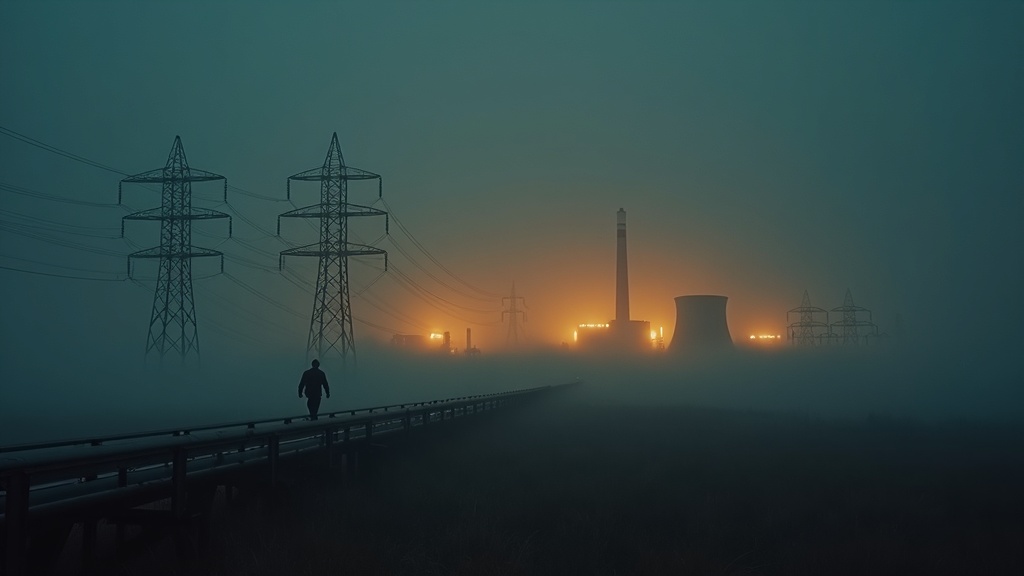
OpenAI ships a 32x cost reduction in three months and the coverage runs on model names. Trump moves on Greenland and it reads as foreign policy. Nuclear permits accelerate at the DOE and it reads as energy policy. None of these are separate stories. They are the same story. AI capability has already decoupled from innovation. What is left is infrastructure. The actors who understand this are moving.
Pattern 1
The Efficiency Floor
$0.37 per task. Three months ago it was over $12. When cost-per-task drops below the cost of the human labor it replaces, deployment stops being strategic and becomes arithmetic. The only variable left is infrastructure capacity.
Nvidia held higher after GTC while the Mag 7 broadly sold off. The market separated hardware from applications and rewarded hardware. That spread is information.
The capability gap between frontier labs and open-weights competitors is now structural. Meta, xAI, and Chinese labs can replicate architectures. They cannot replicate the feedback loop where efficiency gains at scale fund the next efficiency gain.
Within 18 months, "can you build an AI" becomes meaningless. Every serious actor can. The question that determines market position: "can you afford to run it at volume." Nations on expensive or constrained power grids will face a permanent capability deficit that no software improvement can close.
Pattern 2
The Workflow Collapse
OpenAI is pivoting to "coding and business users" because that is where inference volume lives at defensible margins. Excel agents, Codex subagents, Claude as a stateful game master: not demos. Stress tests for one architectural question. Can a model manage state and execute loops over hours without human intervention? Multiple labs answered yes this quarter.
The mechanism is not that AI gets smarter. It is that AI gets reliable enough. Above the reliability threshold, the arithmetic inverts: human oversight of an agentic system costs more than the system itself. Most enterprise workflows are crossing that threshold now, not in 2028.
The SaaS layer is not being disrupted. It is being collapsed into the agentic layer. Slack, Salesforce, Tableau become API surfaces. Revenue follows orchestration, not storage.
40% knowledge worker displacement operates on a 24-month horizon, not 5 years. The models are already good enough. The cost trajectory makes delay economically irrational. Organizations still running 5-year AI planning cycles will arrive after the terms have been set.
Pattern 3
The New Great Game
The US government's $4.2B Ex-Im backing for nuclear fuel chain development is not energy policy. It is AI capability policy. Read the moves in sequence: Canada for hydroelectric, Greenland for rare earths, accelerated nuclear permitting at Idaho, Iran pressure concentrating pain on regional energy supply. Each move fits a conventional geopolitical frame. Together they describe a government that has internalized one equation: AI dominance requires energy dominance.
SocGen's "Race to Empty" tracks oil depletion by country. Goldman flags Iran's inflation shock concentrating in energy. These are infrastructure warfare reported in the commodities column.
Greenland is rare earths. Canada is hydroelectric. Every acquisition target in the current US foreign policy posture has a compute-infrastructure reading that makes more coherent sense than the conventional one.
Currency strength will follow compute capacity within one macro cycle. The dollar's reserve status is anchored by the US capacity to run AI workloads cheaper than any competitor. The "oil wall" is more important than the interest rate cycle. Most portfolios are not positioned for this.
The Hidden Connection
The efficiency gains in Pattern 1 do not reduce total infrastructure demand. They increase it. When cost per task drops 32x, tasks deployed increase by more than 32x. Every efficiency gain in the model layer becomes a demand spike at the infrastructure layer.
The workflow replacement in Pattern 2 converts that demand from elastic to inelastic. An organization that rebuilds around agentic workflows cannot dial them back when costs rise. Aggregated across thousands of enterprises, the AI infrastructure market transforms from a technology market into a utility market. Utility markets price off replacement cost. Replacement cost for energy-to-compute infrastructure takes years to build.
The geopolitical moves in Pattern 3 reveal that state actors already understand the end state. Governments do not move on Greenland's rare earths and Canadian hydro in the same 90-day window by coincidence. The energy and mineral positions being established now are 10-year positions.
Energy-to-compute conversion is the new crude oil. The nations and organizations that control the substrate control the output. Everything else is software running on someone else's foundation.
What Opens Up
Nuclear permitting timelines, hydroelectric auctions, and grid modernization contracts are now leading indicators of AI leadership. Capital tracking chip orders is measuring the output layer while the input layer is being claimed. The $4.2B Ex-Im nuclear fuel backing is an AI infrastructure bet with a 10-year horizon, priced as an energy bet.
Large enterprises build bespoke. Consumers get direct-to-model. The mid-market, 50 to 5,000 employees, is unserved. The window for new entrants is open precisely because the large platforms are still figuring out their own pivot.
Iceland's geothermal. Paraguay's hydroelectric. Quebec's surplus hydro. Hard-to-monetize before. In a world where compute co-locates with power, frontier infrastructure. Early positioning is cheap because most capital has not repriced the asset yet.
Infrastructure positions set now determine who sets prices for the next decade. After that window closes, entry costs will reflect fully-priced scarcity. 32x efficiency in 3 months: the cost curve is falling faster than any model projected. 40% displacement in 24 months: demand is steepening faster than any labor model projects. The gap between those two trajectories is where the infrastructure race is being run. Not in the model layer. It never was.
The dominant narrative frame for AI in 2024 and 2025 was capability. Which model, which benchmark, which lab released first. Benchmarks measure what a model can do at a single inference. They say nothing about what happens when you need 10 billion inferences a month at a margin that works. The infrastructure question was always present. It just was not the interesting question until the models got good enough that it became the only question.
The labs know this. The governments know this. The capital concentrating in nuclear and energy infrastructure for the past 18 months knows this. The gap is in the public frame, not the actual competition.
The race is not between models. The race is between substrates. The substrate is not a metaphor. It is land, power contracts, mining rights, and permits. Whoever locked those in first will not need to compete on anything else.
The era of "let's see where AI goes" ended when the infrastructure bill arrived. The question now is not what the models will do. The question is who owns the ground they run on.
Sources
- OpenAI efficiency benchmarks and task cost data, Q1 2026 internal disclosures and WSJ reporting on strategic pivot to business users
- Dell Technologies: 750GB unified memory system deployments, product announcement cycle Q1 2026
- US Department of Energy: Oklo nuclear powerhouse approval, Idaho National Laboratory, 2026
- US Export-Import Bank: $4.2B backing for General Matter nuclear fuel chain, 2026
- Nvidia GTC 2026: Edge performance vs. Mag 7 divergence, Bloomberg market data
- Societe Generale: "The Race to Empty", global oil depletion rankings by nation, Q1 2026
- Goldman Sachs: Iran conflict inflation shock analysis, energy concentration, Q1 2026
- WSJ: OpenAI strategy memo, Sama interview on Codex and agentic subagents, March 2026
- Knowledge worker displacement modeling: synthesis from McKinsey Global Institute, Anthropic Economic Index, and World Economic Forum Future of Jobs Report 2025